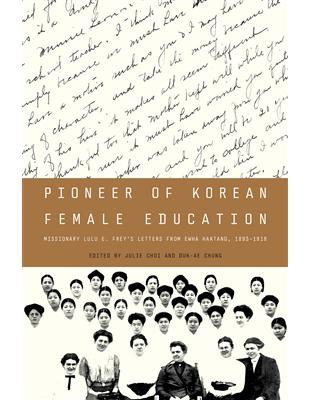
The American who opened women's higher education in Korea
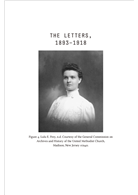
Lulu E. Frey served in Korea for the Woman's Foreign Missionary Society of the Methodist Episcopal Church beginning in 1893. She became a teacher and later principal at Ewha, the country's first girls' school. There, Christian principles were taught along with academic subjects, hygiene, and the sanctity of the woman-centered domestic sphere. The precepts of evangelical Christianity merged with seemingly liberating ideals of modernity. In 1910, the year Japan officially annexed Korea, Frey established Ewha's college program. Many of the young women who studied at Ewha became the first female teachers, nurses, and doctors in Korea and joined a rising cohort of "New Women" across East Asia.
These previously unpublished letters offer intimate insight into the work of running, expanding, and raising funds for a school during the political turmoil and wars that marked the end of the Joseon Dynasty, the short-lived Korean Empire, and the first decade of Japanese occupation.
-------------------------
"In Choi's elegant rendering, the quiet force of Christian missions emerges not simply as an institution, but as a catalyst for modern Korean womanhood—a flame that still burns within Ewha Womans University, the world's largest institution of women's education." ——Yoo Theodore Jun, Yonsei University, author of The Politics of Gender in Colonial Korea
作者簡介:
JULIE CHOI is professor of English at Ewha Womans University, Seoul, South Korea.
DUK-AE CHUNG is professor emerita of English, also at Ewha Womans University.
作者序
叢書主編序
Series Editor's Preface
Paul Allen Miller (University of South Carolina and Ewha Womans University)
It is my great pleasure to write a preface for Pioneer of Korean Female Education: Missionary Lulu E. Frey’s Letters from Ewha Haktang, 1893-1918, edited by Julie Choi and Duk-Ae Chung, published in the joint USC Press and NTU Press series, East-West Encounters in Literature and Cultural Studies. This series is designed to promote scholarship on the fraught history between East Asian literature and culture and an often hegemonic and colonizing influence exerted by European and North American imperial powers. Of course, the outline of the standard narrative of these relations is well-known: from the gun boat diplomacy portrayed in Madama Butterfly, to the burning of the summer palace in the Second Opium War, to the later Korean and Vietnam Wars. And although this narrative holds more than a little truth, it is also overly simplistic and at times condescending in its oft unstated assumptions of the monolithic nature of two supposedly opposed civilizations and implicitly gendered opposition between an active, masculinist colonizing power and a passive, yielding, colonized other.
Pioneer of Korean Female Education: Missionary Lulu E. Frey’s Letters from Ewha Haktang, 1893-1918 is exemplary in showing the limits of this traditional narrative. In it we meet a series of single women, who have set out from the United States as Methodist missionaries. Yes, they came to convert their charges to Christianity, but they also wind up establishing the first university for women on the Korean peninsula. These American religious women, in concert with their Korean pupils and sisters, created an extraordinary community of women that became not only a center of resistance to a traditional Confucian subjugation of women but also a center of learning in which young Korean women would establish a node of resistance to Japanese colonialism. Thus, while this remarkable volume is certainly the story of an East-West encounter, it is far from a story of a simple binary relationship. Rather it unfolds across a complex set of overdetermined gender dynamics, a multipolar system of power, and a utopian dream of building an international community of - if not completely independent then certainly liberated - women.
The correspondence of Lulu Frey is, then, an extraordinary archive in the history of Korea, colonialism, feminism, and religious studies. Expertly edited with a critical introduction by Julie Choi, these letters tell the story of the founding of the first university for women in Korea and the second oldest in East Asia. Today Ewha with 20,000 students is one of the largest universities for women in the world. Frey’s correspondence tells the story of a young woman, who sailed to Korea as a missionary at the end of the nineteenth century to “convert the heathens” and to offer education to other young women who, within their society, had been denied the opportunity. Frey comes loaded with all the prejudices one might expect of a young missionary. But the Korea she arrives in is one that was already under serious colonial pressure from the Japanese and by 1910 would be annexed. Thus, Ewha’s missionary school rather than simply imposing Western culture on Korean indigeneity, which it did, also became a crucible of resistance. These missionaries saw their role as the education of good Christian wives for Korean husbands, but in doing this work they inadvertently established an all-female community of single women who functioned as a gynocentric family unit for many years. Religious conversion and even conformity, thus, became an at times ironic means of resistance to colonial and patriarchal power. It is a remarkable story.
前言
Preface (Excerpt)
Julie Choi
Lulu E. Frey (1868-1921) was a first-generation missionary deployed by the Woman’s Foreign Missionary Society (WFMS) of the Methodist Episcopal Church (North) to Korea in 1893. She served as teacher at Ewha Haktang (School), the first girls’ school in Korea founded by the WFMS in 1886, and principal from 1907 until her death in 1921. Frey established the college program at Ewha in 1910. In 1970, Ewha Womans University was able to acquire Frey’s letters to her family from 1893-1918 as well as the short journal (1919-21) that covers her activities during her last furlough, when she met and communicated actively with fellow missionaries as well as Koreans in America working for independence from Japan, including Seo Jaepil (Dr. Philip Jaisohn) and Syngman Rhee, later to become the first president of the Republic of Korea. The daughter of Frey’s younger sister Georgia, Myra (née LeSourd), Mrs. Willis T. Bradlee, gifted the letters to the school. They were accompanied by a letter Frey received from Syngman Rhee in 1920. Though they are meticulously preserved, the task of transcribing and publishing the 105 letters has been delayed for several reasons. Although Frey’s handwriting is on the whole quite clear, the fineness of the writing paper, often written on both sides, meant that Frey’s words were not always readily legible. Some of the letters written during illness or times of turbulence display a much more hurried hand, and the fragile condition of others rendered them difficult to read. The personal nature of the letters demanded painstaking research into family members, friends, and professional associates in America for whom the university had no records. The references to the many fellow missionaries not only in Korea, but also in Japan and China also took time to unravel. The process of puzzling out names of steamships, warships, local businesspeople, and acquaintances both in America and in Korea, was at times a guessing game that took further detective work. On the whole Frey’s spelling and punctuation have been preserved throughout. Her emphasis by underlining, however, has been changed to italics in the printed text. The format of locations and dates that open each letter has been edited for consistency, and locations have been added to the headings of Frey’s journal entries.
The letters are addressed to three members of Frey’s immediate family: father (10), mother (82), and younger sister Georgia (16). As the table of contents reveals, there are a few letters kept by the family written by other people and forwarded to or by Frey. They include notably a letter written by the founder of Ewha Haktang, Mrs. Mary F. Scranton, dated July 20, 1894, addressed to Frey and fellow missionary Josephine O. Paine. The two were summering in Japan as war broke out between China and Japan on the Korean peninsula, and they were unable to return as planned. There is also a letter to Frey from a teacher, Yukiye Nakao, at the Methodist girls’ school in Nagasaki, who had studied art in America and returned to Japan on the steamer China that brought Frey out on her first journey in 1893. The last letter of the collection is from Syngman Rhee writing to Frey, who was on furlough, from Honolulu. Frey asks her mother soon after arriving in Korea to keep her letters as a record for future reference to recall all that seemed so fresh and new to her as she embarked upon her career. She writes, “So if you can keep my letters for me I will find them helpful when I come home and am expected to talk. I shall forget about those things which seemed strange to me at first and the same to you and others, by that time, for already I am becoming accustomed to many things” (February 20, 1894).
As a result, the bulk of the letters covers the earliest years, with 75 letters from September 1893 to the end of 1896 when Frey’s mother was most faithful in preserving them, not only as a record for her daughter’s future use, but also for the family to send out to various local and evangelical publications as foreign news from a young female missionary in an exotic land. Such material was important for keeping aflame the female missionary movement that was the largest organized woman’s public cause in the second half of nineteenthcentury America. There are no letters from 1897, and letters thereafter are sparse and few and far between. The last of the five letters from 1898 dated November 23 and addressed to her father reports fully on the political upheaval caused by the Independence Club’s activities at the time. There is a sudden surge of letters (16) from 1904 that covers the tension building up to the Russo-Japanese War. The years covered in Frey’s letters were some of the most tumultuous in all Korean history when the tiny nation became the choice morsel sought out by all the neighboring great powers. Frey’s letters report on the Sino-Japanese War (1894-95), the queen’s assassination by the Japanese (October 1895), the king’s exile at the Russian legation (1896-97), and the Russo-Japanese War (1904-5), amid the day-to-day school activities of teaching, provisioning, nursing, and burying the dead.
These letters provide a fascinating glimpse into the day-to-day workings of running a school, building for school and church, traveling, evangelical itinerating, even while witnessing war and political turmoil that mark the close of the Joseon Dynasty. The tone and tenor of the letters addressed to her father, mother, and sister Georgia—the three main recipients of the letters—are quite different. The most personal and intimate details are reserved for her mother who is her primary confidante and mentor in the early letters. The deep love she expresses for her mother reflects the kind of affect often demonstrated in female friendships and mother-and-daughter relationships in the Victorian period. When Frey realizes that her mother often reworks even some of the personal missives directed to her for publication, she pleads that she cease to do so, because she does not want to think of a larger public when addressing her own mother. Discussion of patterns, fabrics, gloves, and hats as well as financial details concerning insurance and loans take up a large part of many letters and provide a valuable overview of the day-to-day concerns of women trying to maintain a certain standard of living in the period. Living in decency and comfort is not merely a personal ambition, but the foundation for Victorian women’s ideal of “civilized” life centered on female taste and judgment. Assurances of financial assistance and ideas for fiscal planning make up a large portion of letters written after the sudden death of the father in 1900. Georgia is only a child of 11 in 1893, and so the earliest letters addressed to her reflect the care and admonishments to a beloved baby sister. Frey often advises her mother on how to best perfect Georgia’s education, wishing for her a more complete education than the one she herself received. As Georgia grows older and once their father passes away, Frey begins to rely more on her sister for the care of their mother.
....................
Frey recounts how the American Minister at the US legation in Korea, John M. B. Sill (1831-1901), employed the quote in a talk given on Tract Sunday to urge why even ordinary people must try to follow the tracks (pun on tracts) of Jesus: “He said Longfellow called them ‘footprints’ and gave the quotation ‘footprints on the sands of time.’ Spoke of the footprints of Jesus and how while tracts were good, ‘tracks’ or the Christ-like life before the people was better. Think of it—A diplomat preaching to missionaries” (October 22, 1894). The effusive Victorian sentimentality that made “A Psalm of Life” one of the most popular poems of its time also renders it less popular today, but its optimistic spirit and religious enthusiasm urging Christian action espoused the spirit of many young Americans who joined organizations like the Student Volunteer Association (SVA), which sought to evangelize the entire world in their generation.
Frey always thought of herself as merely an ordinary missionary, and she is not celebrated enough even in Korea where she played such a pioneering role in female education. It is my hope that these letters, her “footprints on the sands of time,” will demonstrate how faith and quiet fervor can effect transformative change despite the self-perceived smallness and ordinariness of the actors who take part in this history.
I would like to thank my coeditor, Duk-Ae Chung, for her enthusiasm and passion for this project. Thanks also go to Hyunji Son at Ewha Archives, who provided assistance and research every step along the way. The project could not have reached completion without the leadership of the Director of Ewha Archives, Ok-kyoung Baek, and the generous support of Ewha Presidents Eun Mee Kim and Hyang-Sook Lee. All shortcomings and errors are my own.
叢書主編序
Series Editor's Preface
Paul Allen Miller (University of South Carolina and Ewha Womans University)
It is my great pleasure to write a preface for Pioneer of Korean Female Education: Missionary Lulu E. Frey’s Letters from Ewha Haktang, 1893-1918, edited by Julie Choi and Duk-Ae Chung, published in the joint USC Press and NTU Press series, East-West Encounters in Literature and Cultural Studies. This series is designed to promote scholarship on the fraught history between East Asi...
目錄
List of Illustrations
Series Editor’s Preface
Preface: “Footprints on the Sands of Time”
Note on Romanization
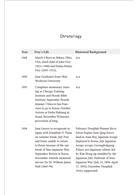
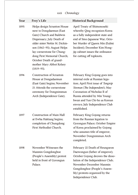
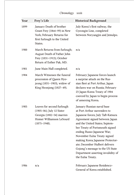
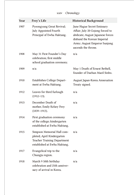
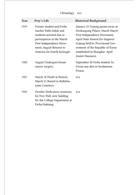
Chronology
Introduction: Frey’s Work for Female Education at Ewha in Historical Context
The Letters, 1893-1918
Last Journal, 1919-21
Appendix A. Letter to Miss Conklin, 1905
Appendix B. Letter from Syngman Rhee to Lulu E. Frey, 1920 (Honolulu)
Appendix C. Letters Received by Georgia Frey LeSourd from Ewha Haktang, 1919-34
Index of Names
Glossary
Notes
Index
List of Illustrations
Series Editor’s Preface
Preface: “Footprints on the Sands of Time”
Note on Romanization
Chronology
Introduction: Frey’s Work for Female Education at Ewha in Historical Context
The Letters, 1893-1918
Last Journal, 1919-21
Appendix A. Letter to Miss Conklin, 1905
Appendix B. Letter from Syngman Rhee to Lulu E. Frey, 1920 (Honolulu)
Appendix C. Letters Received by Georgia Frey LeSourd from Ewha Haktang, 1919-34
Index of Names
Glossary
Notes
Index


 收藏
收藏

 二手徵求有驚喜